The best way to start Grim Trials is to treat every run as both combat practice and permanent progression. Learn when to alternate between your scythe and crossbow, collect materials even when a run is going badly, return to the Academy to craft and complete quests, and use Soul Runes and the Skill Tree to strengthen the parts of your build that consistently help you survive. Blessings then provide the randomized layer that changes each attempt.

What should you do first in Grim Trials?
Do not judge your first few attempts only by how far you reach. Grim Trials is an action roguelite built around repetition. The official game description confirms that experience and materials earned by Avelin remain after she falls, so an unsuccessful run can still improve the next one. Your first objective should therefore be to learn enemy attack windows while gathering as much useful progression material as you safely can.
The game takes place across hex-grid arenas containing enemies, traps, sinful souls and seven major bosses. Early rooms are an opportunity to learn spacing rather than a race to clear as quickly as possible. Watch how enemies telegraph attacks, learn which animations leave them vulnerable, and keep enough room to reposition instead of repeatedly committing to long melee strings. The August 29 update specifically improved melee attack telegraphs and tracking behavior and reduced obstacles that could interrupt dashes or leave Avelin stuck, so current combat should be judged against the patched release rather than older demo footage.
Learn the scythe-and-crossbow rhythm
Grim Trials deliberately gives Avelin a melee and ranged weapon together. The official description says the combat system rewards clever use of the dual-wielded scythe and crossbow. For a beginner, the important lesson is not to decide that you are exclusively a melee player or exclusively a ranged player before understanding why the second weapon exists.
Use melee when you have a reliable opening and can leave before the next dangerous attack. Use ranged pressure when closing the distance would expose you unnecessarily. Switching between those roles helps preserve damage uptime without forcing unsafe engagements. This is particularly useful against bosses, where learning the pattern is more important than squeezing one extra attack into a closing window.
Do not assume an old ranged build is still optimal. Patch v1.0.20260824 adjusted ranged weapon cooldowns, rebalanced several ranged combinations and changed the Anubis Blessing as part of ranged-build balancing. The practical takeaway is that a guide or video made from an earlier build may demonstrate the right mechanics while recommending outdated numbers or combinations.
Understand what persists after death
The simplest mental model is to separate permanent preparation from temporary run power. Experience and materials persist. Crafted equipment expands what you can bring into future attempts. Academy quests and relationships provide another progression track. Soul Runes feed into the Skill Tree. Blessings, by contrast, are randomized choices obtained during a run and should be treated as the adaptive part of your build.
| System | Role | Beginner priority |
|---|---|---|
| Experience & materials | Persistent resources | Keep collecting them even on a weak run. |
| Crafting | Weapons, gear and consumables | Craft toward a clear problem instead of spending blindly. |
| Soul Runes / Skill Tree | Long-term build customization | Build a dependable core before chasing narrow combinations. |
| Blessings | Randomized run power | Choose effects that reinforce the build the run is already giving you. |
| Quests / Affinity | Academy progression | Check NPCs between runs instead of treating the Academy as a menu. |
Do not ignore Soul Runes and the Skill Tree
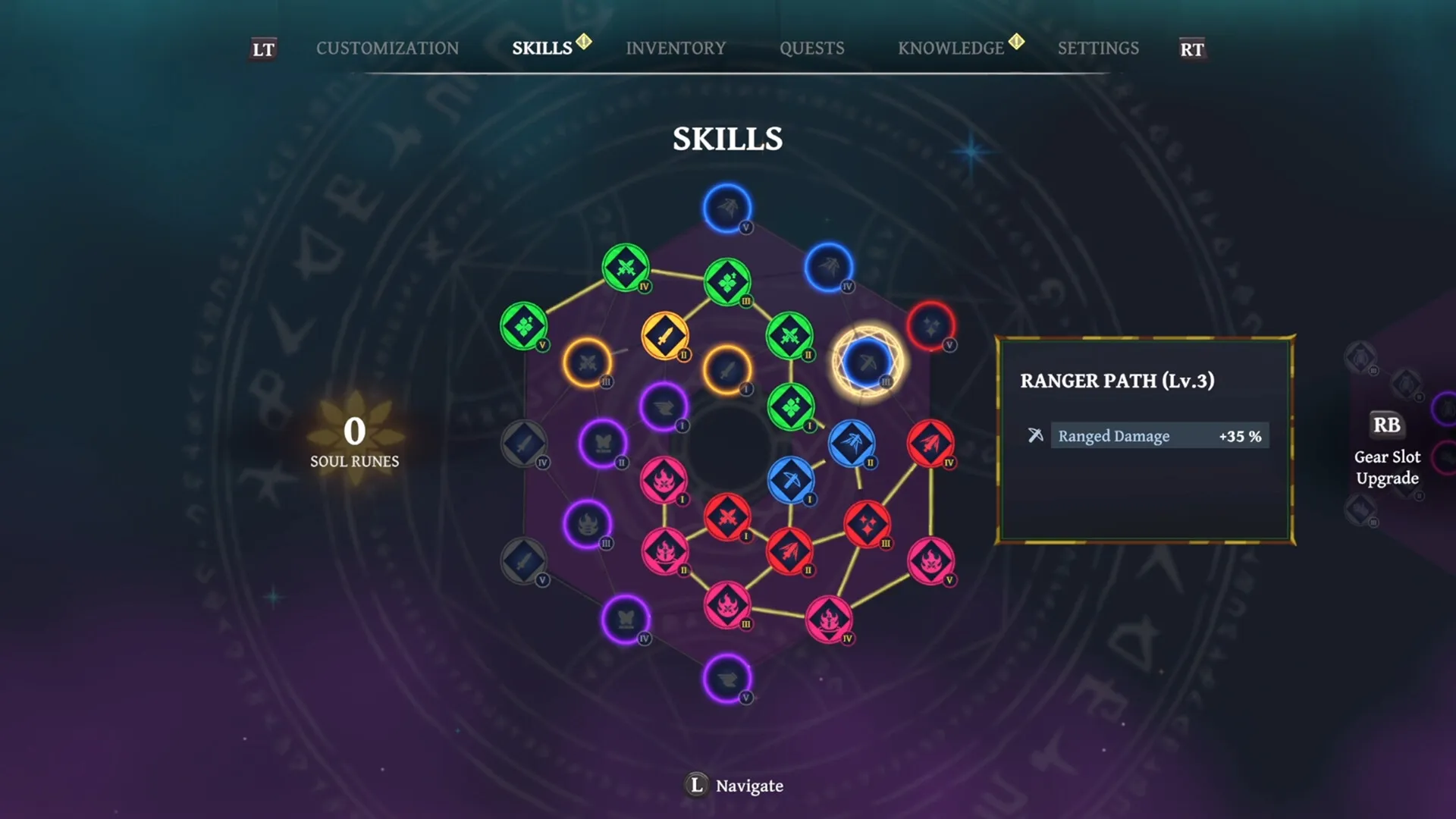
Soul Runes are one of the most important systems missing from many pre-release beginner guides. The released game ties them to Skill Tree progression, and the achievement list confirms that both Skill Tree nodes and Slot Upgrade nodes form part of the full progression structure. A late-game achievement requires activating all of them, making the tree more than a temporary demo feature.
The August 24 patch also fixed two Soul Rune problems: some late-game players could stop receiving Soul Runes, and removing a Soul Rune from the Skill Tree could make it disappear instead of refunding correctly. That matters for beginners because it confirms that reconfiguring the tree is intended to return the removed resource. You should experiment rather than assuming your first allocation has to remain forever.
Another easy-to-miss connection is Gear Enchantment. The same patch improved its quest/tutorial flow and added clearer terminology explaining how Gear Enchantment is accessed through the Skill Tree. If a progression feature seems unavailable, check your tree and relevant Academy quest state before assuming that the game expects you to find a separate crafting menu.
Craft for a purpose, not just because you can
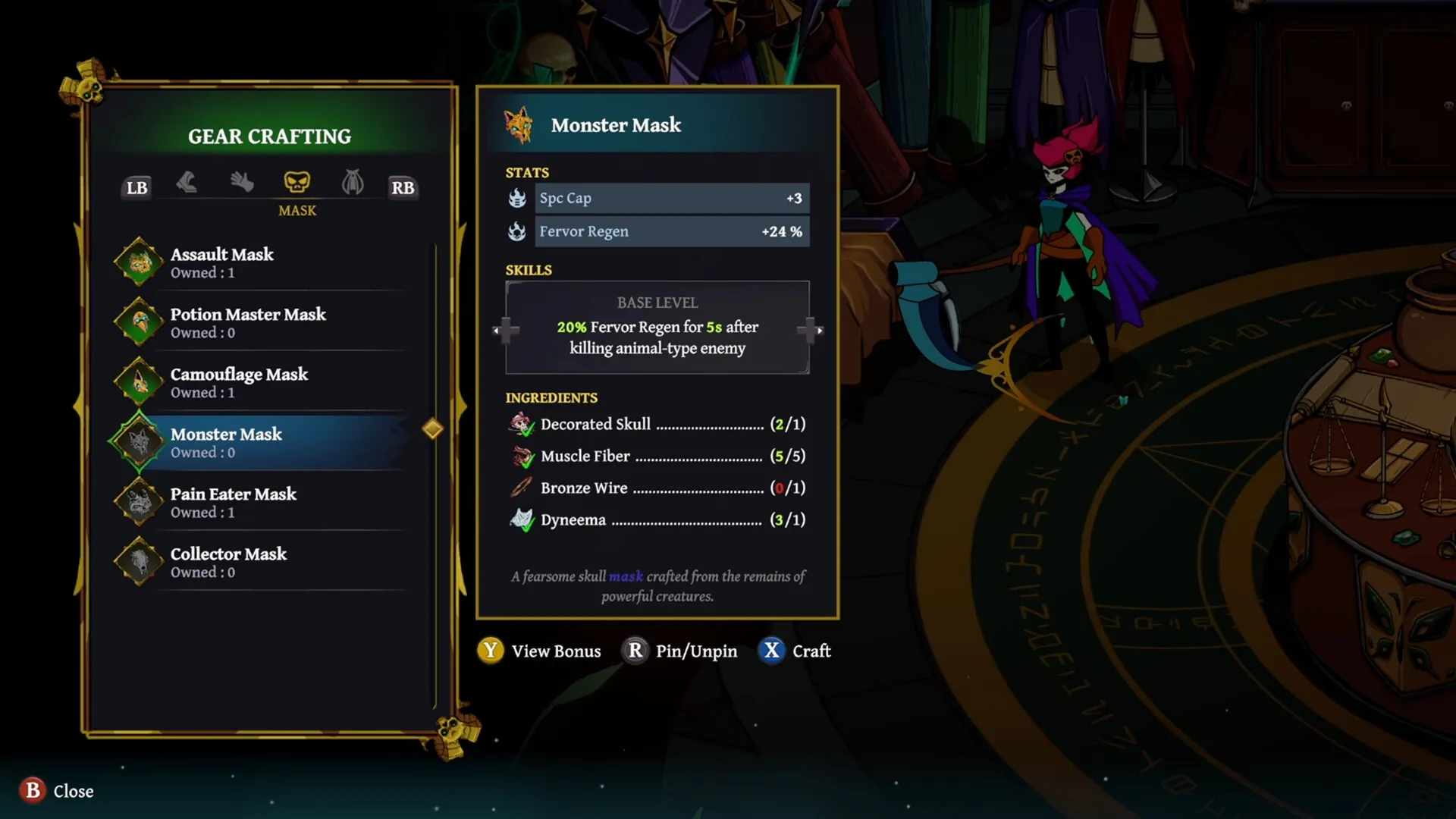
Materials gathered in combat can be turned into weapons, gear and consumables with the Academy's mentors. New players often make one of two mistakes: hoarding everything because they fear wasting materials, or crafting every available option without considering whether it improves their current plan. A better approach is to identify what is ending your runs and spend toward that problem.
If you struggle to stay alive long enough to learn a boss, prioritize a more forgiving setup rather than a theoretical maximum-damage combination. If normal rooms are comfortable but bosses take too long, look for upgrades that improve sustained damage without making positioning harder. As you learn the crafting system, pay attention to Mastercrafted equipment as well: the released achievement list includes a challenge for completing a Trial Ground run with a Level 3 Mastercrafted Weapon and Gears, confirming that Mastercrafted equipment is part of the longer progression path.
Patch v1.0.20260824 fixed a bug that could cause Crafting to produce no item and improved Crafting Recipe layout, readability and navigation. It also adjusted multiple Gear buffs and values. If you played immediately at launch and abandoned crafting because it behaved strangely, revisit it on the current version.
How should beginners choose Blessings?
Blessings are where a run becomes less predictable. The Gods of Death offer randomized Blessings during a run, so you cannot build your entire strategy around receiving one exact option every time. Start with a simple rule: when two choices look similarly useful, favor the one that works with something you already have rather than opening an unrelated direction.
This does not mean every run needs a perfectly optimized synergy. Early on, survivability, reliable damage and effects you can actually trigger are more valuable than a complicated combination that only works under ideal conditions. The achievement Omnitheism asks players to experience every Gods of Death Blessing, so experimentation is part of the game's broader completion path. Trying unfamiliar Blessings is useful; just distinguish experimentation from a serious attempt to push farther.
Return to the Academy and talk to people
The Academy is not simply the screen between combat runs. Official descriptions present it as the place where Reapers train, work with mentors, accept quests, build relationships and learn the stories of other characters. The released achievement list makes those systems concrete: there are Affinity achievements for Pytra, Milyun, Ivanya, Iskra, Kai, and Breone & Nameles, alongside quests such as The Special Delivery and Three Headed Snake.
For a first playthrough, make a habit of checking characters after meaningful progression or a completed Trial. New dialogue and quest progress can matter to more than story completion. The game also includes a normal ending and a true-ending achievement, so players interested in seeing everything should not treat relationships and side activities as disposable flavor.
How to approach your first bosses
Grim Trials contains seven sacrilegious bosses associated with the seven deadly sins. The released achievement list names Acedia, Avaritia, Gula, Ira, Luxuria, Invidia and Superbia. For beginners, the correct first goal in a new boss encounter is information. Learn what starts an attack, where the safe area forms, which attacks track Avelin, and which recovery windows are long enough for melee pressure.
Acedia is especially useful as an example because the developers have already adjusted the encounter across builds, including summoned enemies and visual readability. The August 29 update also added a visual cue to boss rooms. This is why memorizing a launch-week cheese strategy is less valuable than learning the underlying dodge and positioning rules.
A practical early-game routine
- Finish onboarding and learn the basic controls. There is an achievement for completing the Grim Reaper apprentice onboarding, so follow the introductory systems instead of rushing past every prompt.
- Enter early runs expecting to learn. Focus on enemy tells, dash timing and the transition between scythe and crossbow.
- Collect materials throughout the run. A death does not erase those persistent resources.
- Check the Academy after returning. Talk to mentors and peers, advance quests and watch for systems that have just unlocked.
- Use Soul Runes deliberately. Strengthen a coherent part of the Skill Tree and remember that removed runes are supposed to be refunded.
- Craft toward your current weakness. Do not spend solely because an item is new.
- Let Blessings shape the attempt. Reinforce useful synergies instead of forcing the exact same build every run.
- Against a new boss, prioritize pattern recognition. Once you can survive the full attack cycle, optimize damage.
Common Grim Trials beginner mistakes
- Thinking death means zero progress. Experience and materials persist, making unsuccessful attempts part of advancement.
- Ignoring one of the two weapon types. Scythes and crossbows are designed to complement one another.
- Following demo-era balance advice as if it were current. Ranged cooldowns, Gear values, Blessings and bosses have already received post-launch changes.
- Forgetting the Academy. Quests and Affinity are genuine progression/completion systems.
- Ignoring Soul Runes. They are central to the released Skill Tree progression loop.
- Forcing one Blessing setup every run. Randomized choices reward adaptation.
- Spending materials without a goal. Craft upgrades that address a specific weakness or advance a build you understand.
Watch official Grim Trials gameplay
The embedded release-date trailer is an official visual reference for Grim Trials combat, Avelin's weapons, arenas and presentation. It is useful for seeing the pace of scythe-and-crossbow combat, but use the written advice above for current progression and balance because the game has received post-launch patches.
Beginner FAQ
Do you lose all your progress when you die?
No. The official game description states that experience and materials earned by Avelin remain after she falls. A run ends, but those retained resources continue contributing to long-term progression.
Should I use the scythe or crossbow?
Use both. The combat system is explicitly designed around combining the two weapon types. Melee provides close-range pressure while the crossbow helps maintain useful damage and spacing when approaching is unsafe.
Can Soul Runes be removed from the Skill Tree?
Yes. The August 24 patch fixed a bug where removed Soul Runes could disappear instead of being refunded, confirming that removal and refunding are part of the intended system.
How many major bosses are there?
There are seven major Sin bosses: Acedia, Avaritia, Gula, Ira, Luxuria, Invidia and Superbia.
Should I rush the main path?
Not if you want the full progression experience. Academy quests, Affinity, crafting, Skill Tree completion and other side objectives are represented directly in the released achievement list and can support both progression and completion goals.
What to read next
Sources & verification
- Grim Trials on Steam — combat, seven bosses, crafting, Skill Tree, Blessings, Academy and persistent experience/materials
- Nintendo official Grim Trials page — full-release gameplay systems, Academy, crafting and August 20 release information
- Grim Trials Steam Community announcements — v1.0.20260824 and v1.0.20260829 post-launch updates
- Steam global achievements — bosses, Affinity, quests, crafting, Trial Ground and Skill Tree completion objectives
- Official PlayStation release-date trailer — embedded visual reference for gameplay