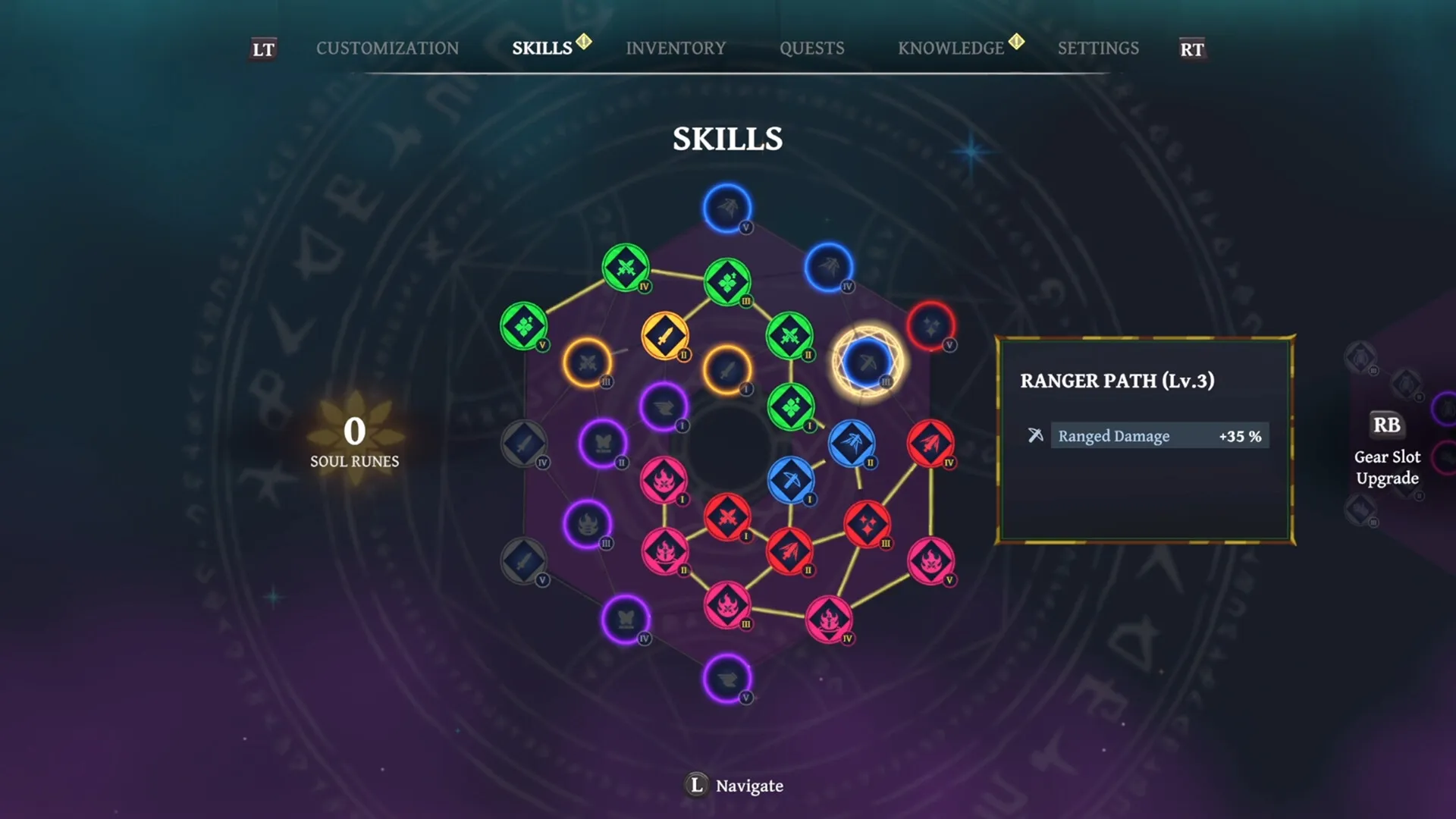
Grim Trials’ skill system is the permanent build layer that connects Soul Runes, the Skill Tree and Slot Upgrades to your crafted equipment. You prepare this foundation before a Trial Ground run, then randomized Blessings add temporary run-specific power on top of it. If you are deciding where to spend progression resources, start with the Skill Tree Guide and Soul Runes Guide, then use this hub to understand how those systems fit together.
How the Grim Trials skill system works
Official store and publisher descriptions present character building as a combination of crafted equipment, skills invested through an expansive Skill Tree and randomized Blessings earned during a run. That distinction is useful because these systems do not all reset in the same way. Weapons, equipment, persistent materials and progression remain part of Avelin’s long-term growth, while Blessings are the adaptive layer you build around once a run is already underway.
The Skill Tree therefore should not be treated as an isolated menu that you fill once and forget. It determines what your prepared build can do before room-to-room randomness starts influencing the run. A player using a ranged-heavy setup may want different permanent support than a player leaning on melee pressure, and someone learning a difficult boss may value survivability or reliable utility more than a fragile damage interaction. Because the game supports build experimentation, your permanent progression should serve the weapon and playstyle you are actually using rather than a copied “best build” from an older patch.
Soul Runes: the resource behind the Skill Tree
Soul Runes are the key progression resource used to activate Skill Tree and Slot Upgrade nodes. Post-launch player documentation describes souls earned through play accumulating toward Soul Runes, while Academy side content can also contribute to progression. A release review from Pink Fuzzy Bunnies describes Soul Runes as the game’s practical level-up currency: they are inserted into the Skill Tree, can support passive bonuses and active combo abilities, and can be removed so players can experiment with different setups.
The most important official evidence is the v1.0.20260824 patch. Glory Jam fixed an issue where some late-game players could no longer obtain Soul Runes and separately fixed a bug where a Rune removed from the Skill Tree could disappear instead of being refunded. Those fixes change how older launch-week reports should be interpreted. If you find a guide warning that respec permanently destroys Soul Runes or that late-game acquisition simply stops, check its date before treating that behavior as current.
Skill Tree: passives, combat tools and build identity
The Skill Tree is where Soul Runes become usable character power. Current third-party release documentation reports passive benefits such as attack speed, movement speed and additional health alongside active abilities that appear as combat combos. Exact node names, values and optimal paths can be balance-sensitive, so this wiki does not invent a complete node database from screenshots or extrapolate values from older demo footage.
What is stable is the planning principle. Start with what your build needs to function. If your weapon timing feels comfortable but survival is poor, a reliable defensive or mobility improvement may produce more real progress than another theoretical damage increase. If you are repeatedly changing weapon families, keep enough flexibility to test the new rhythm rather than forcing every weapon into the same permanent setup. The Combat Guide explains the movement and attack fundamentals that should inform those choices.
It is also worth separating Skill Tree power from Blessing power. Blessings are randomized during runs, which means you cannot guarantee that a particular deity or effect will appear. A functional Skill Tree setup should therefore make your build playable before the “perfect” Blessing combination arrives. Use Blessings to specialize and amplify a sound foundation rather than to rescue a permanent setup that only works when one random offer appears.
Slot Upgrades and Maximum Occupancy 120
The achievement Maximum Occupancy 120 is an important completion marker for the skills system. Current achievement documentation defines its objective as activating all Skill Tree and Slot Upgrade nodes. The title includes the number 120, but that does not justify claiming that the game has exactly 120 Skill Tree nodes. The achievement wording groups Skill Tree and Slot Upgrade completion together, and the public evidence does not provide a clean official node-by-node count.
For completion, the practical goal is therefore simple: work toward activating every required node in both parts of the Skills interface rather than trying to reverse-engineer the title into a node total. A current third-party trophy guide also reports that Soul Runes are needed across both areas and that full completion may continue after most other objectives are finished. Treat any exact remaining-Rune estimate as player-tested route information rather than a guaranteed universal requirement.
Why Gear Enchantment belongs in the Skills section
Gear Enchantment sounds like a crafting-only system, but the August 24 patch explicitly ties access to the Skill Tree. The update improved the Gear Enchantment quest and tutorial flow and added clearer wording so players would understand how to access the feature through the Skill Tree. That is why this hub links directly to the Gear Enchantment Guide instead of treating enchantment as completely separate from skill progression.
If Gear Enchantment appears unavailable, do not assume your save is broken or that a hidden material is missing. First check your Skill Tree progression and the related Academy quest/tutorial state. The patch notes specifically acknowledge that players could miss how the system was accessed, so progression clarity—not just crafting materials—matters here.
The four build layers to think about together
| Layer | Role | Planning question |
|---|---|---|
| Weapons & Gear | Prepared equipment baseline | What combat rhythm and survivability does this loadout give me? |
| Skill Tree | Persistent stats and combat abilities | Which permanent nodes make this loadout reliable? |
| Slot Upgrades | Additional persistent capacity/progression | Which remaining permanent slots are still limiting the build? |
| Blessings | Randomized run specialization | Which current offer best reinforces what this run already does? |
This layered view is more durable than a fixed tier list. Grim Trials has already received post-launch balance changes to Gear values, ranged combinations, ranged cooldowns and the Anubis Blessing. A build guide that ranks one setup without naming its patch version can become stale quickly. The permanent systems should instead be evaluated by whether they support your chosen equipment, solve a current progression problem and remain useful when a random Blessing does not appear.
A practical Skills progression route
- Learn your weapon first. Use the early game and Training Ground to understand the attack rhythm you actually want to support.
- Spend Soul Runes on reliable value. Prioritize nodes that improve the build you can execute consistently rather than chasing an unverified meta.
- Reconfigure when your loadout changes. Current patch behavior supports refunded Soul Runes when they are removed, so experimentation is part of the intended system.
- Check Slot Upgrades as well as the main tree. Completion requires both areas, not only the most visible Skill Tree branch.
- Resolve Gear Enchantment access through progression. If the feature is confusing or unavailable, use the current quest/tutorial and Skill Tree route before assuming a crafting bug.
- Let Blessings adapt the run. Do not build permanent progression around a random effect that may not appear.
- Recheck after balance patches. Node values, Gear interactions and combat synergies are more likely to change than the overall progression structure.
What this hub deliberately does not claim
We do not infer exact node counts from the achievement name Maximum Occupancy 120. We do not publish unsupported Soul Rune drop percentages, fixed farming rates or a universal “best” tree. We also do not turn demo-era values into release-build facts without current evidence. Where an exact mechanic comes from a player-tested guide or review rather than official documentation, it is labeled as secondary evidence.
This matters because the Skills system is one of the areas that received a direct post-launch progression fix. A verification-first approach is more useful than fake precision: players need to know what resource is persistent, how respec is intended to work, where Gear Enchantment connects and which recommendations may change with future balance updates.
Related Grim Trials skill and build guides
Sources & verification
- Grim Trials on Steam — official build structure, Skill Tree, randomized Blessings and persistent progression framing
- Official Steam Community announcements — v1.0.20260824 Soul Rune fixes and Gear Enchantment Skill Tree clarification
- Publisher game page — expansive Skill Tree, equipment customization and persistent upgrades
- Pink Fuzzy Bunnies release review — player-tested Soul Rune socketing, passive/active ability examples and respec behavior; treated as secondary evidence
- Gamerbase trophy guide — player-tested Maximum Occupancy 120 completion context; treated as secondary evidence