Soul Runes are one of Grim Trials’ main permanent-progression resources. You earn Souls through play, convert enough of that progression into Soul Runes, and then socket those runes into the Skill Tree to activate stat upgrades and combat abilities. Soul Runes can be removed and reassigned, and the August 2026 post-launch patch fixed a bug that could cause removed runes to disappear instead of being refunded.
What are Soul Runes?
Soul Runes are best understood as the bridge between the Souls you accumulate from fighting through the Trial Grounds and the permanent build choices you make back at the Academy. Grim Trials’ official store descriptions emphasize that experience and materials persist when Avelin dies, while the released game’s Skill Tree gives that persistent progress somewhere meaningful to go. Post-launch review coverage describes Souls as the experience-like resource and Soul Runes as the spendable progression pieces that slot into the Skill Tree.
This distinction matters because Soul Runes are not the same thing as randomized Blessings. Blessings are obtained during a run and help shape the temporary build you are using for that attempt. Soul Runes are part of your longer-term account progression and Skill Tree setup. In practical terms, Blessings answer the question “what did this run give me?” while Soul Runes help answer “what permanent options has Avelin unlocked over time?”
How do you get Soul Runes?
The most consistent public description comes from post-launch playthrough coverage: Souls are collected as you complete runs, and after reaching the game’s required Soul threshold you receive a Soul Rune. The exact threshold can depend on progression state, and this guide deliberately does not publish a fixed number without a current in-game source. What is well supported is the overall loop: fight, bring back Souls, convert that long-term progress into Soul Runes, and spend those runes in the Skill Tree.
Academy sidequests may also contribute to your Soul Rune progression. A post-launch review reports that several NPC questlines can reward Soul Runes alongside gear sets, potion access and other progression benefits. Because quest rewards can be tied to story or affinity steps, players who only talk to the main-story NPC and immediately re-enter a Trial may leave useful progression on the table. A good habit is to check Academy characters after meaningful story progress before launching the next run.
How Soul Runes work in the Skill Tree
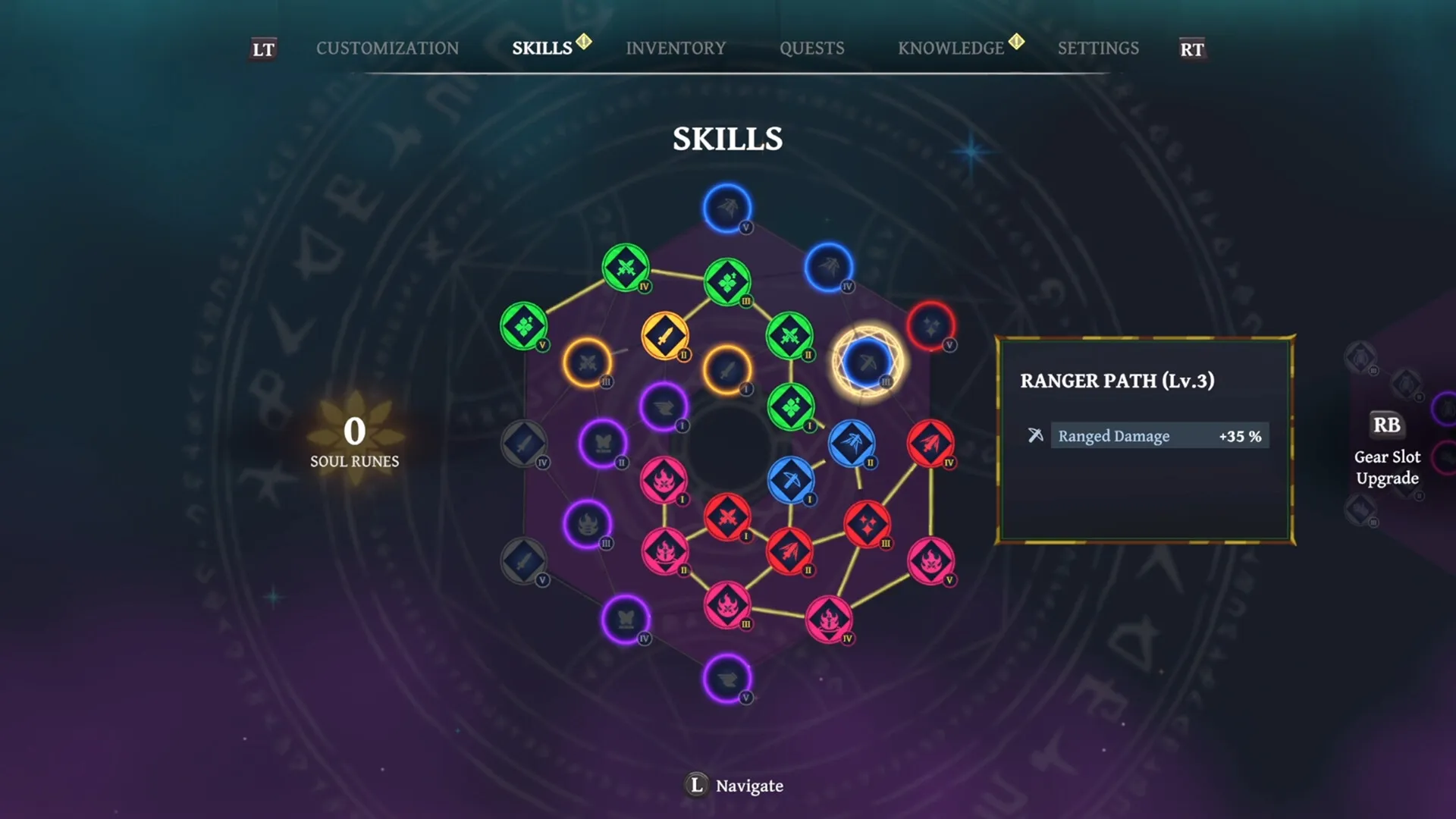
The Skill Tree is where Soul Runes become actual power. Current and pre-release footage both show a radial tree with connected paths, while post-launch coverage confirms that the tree includes passive stat improvements and active combo-style abilities. Examples documented by reviewers include improvements to attack speed, movement speed and maximum health, as well as active combat effects. The important design idea is not one specific node but the fact that the tree supports different build directions rather than forcing every player down one identical route.
That makes Soul Runes more valuable when you spend them with a plan. A melee-heavy setup may care more about survivability, movement and reliable close-range uptime. A crossbow-focused setup may prefer nodes that improve ranged pressure or create safer damage windows. Hybrid builds can use the tree to smooth out weaknesses before randomized Blessings begin shaping the run. For a broader breakdown of how nodes and slot upgrades fit together, see the Grim Trials Skill Tree Guide.
Can you remove or respec Soul Runes?
Yes. Soul Runes can be removed from the Skill Tree, which allows you to experiment rather than treating every early allocation as permanent. That flexibility is one of the strongest parts of the system because Grim Trials asks you to combine equipment, Skill Tree choices and Blessings. A setup that feels good with one weapon may be less effective after you craft a different weapon set or start favoring another playstyle.
There is also an important release-history detail here. The developers specifically fixed a bug in v1.0.20260824 where Soul Runes removed from the Skill Tree could disappear instead of being refunded correctly. That patch note confirms two useful facts at once: removed runes are supposed to be refunded, and players on the current version should not treat the old disappearing-rune behavior as intended design.
How to spend Soul Runes efficiently
First, buy consistency before novelty. Early runs are usually limited more by survivability, movement mistakes and weak baseline damage than by the absence of an elaborate endgame combo. Nodes that make your ordinary combat loop safer can be more valuable than a specialized effect you only trigger occasionally.
Second, spend around the weapons you actually use. Grim Trials is built around melee and ranged weapon swapping. If your strongest crafted gear currently pushes you toward one side of that system, use Soul Runes to support that real build rather than an imaginary future one. Because runes can be reassigned, you are free to change direction when your equipment improves.
Third, leave room for experimentation. The Skill Tree and Gear Slot Upgrade systems sit close together in the Skills interface, and the August 24 patch also clarified access to Gear Enchantment through the Skill Tree. As more systems open up, your idea of the “best” allocation can change. A flexible tree is more useful than blindly copying a screenshot from an older Demo.
Fourth, do not confuse permanent power with run-specific power. Soul Runes improve your baseline options, but randomized Blessings still matter enormously during individual runs. The strongest strategy is usually to build a stable permanent foundation and then let Blessings amplify whatever the run gives you.
Soul Runes in late-game progression
Post-launch coverage indicates that players can eventually acquire enough Soul Runes to fill the Skill Tree. Steam’s achievement list also includes Maximum Occupancy 120, which requires activating all Skill Tree and Slot Upgrade nodes. The title of that achievement should not be interpreted as a verified claim that the Skill Tree contains exactly 120 ordinary nodes; the achievement text is the safer piece of evidence. What it does establish is that fully activating the combined Skill Tree and Slot Upgrade progression is an explicit completion goal.
This creates a useful shift in priorities. Early on, a Soul Rune is a scarce build decision. Later, the focus becomes completion, experimentation and optimizing which active paths make sense with particular weapons and Blessings. That is why respec functionality matters: even when you have a large Rune pool, you still want the freedom to test different routes rather than remain locked into the first build that helped you survive the opening Trial.
What changed in v1.0.20260824?
The August 24 build is the most important Soul Rune patch so far. It fixed a late-game progression issue that could stop Soul Runes from being obtained, and it fixed the refund problem when removing runes from the Skill Tree. The same update also improved the Gear Enchantment tutorial and clarified how that feature is accessed through the Skill Tree. Together, those changes make the Skills interface much more important than older pre-release guides may suggest.
If you are troubleshooting Soul Rune progression, confirm that your game is updated before following old forum advice. Reports written before this patch may describe bugs that are no longer expected behavior. Likewise, if you are comparing build screenshots from the Demo, use them only to understand the layout and concept of the system; exact values and balance should come from the released version.
Soul Rune video reference
The embedded PAX East 2026 coverage is pre-release footage, but it is unusually relevant because it specifically describes earning Soul Runes from combat and using them to unlock Skill Tree abilities. Treat the footage as a visual explanation of the system rather than a source for exact current node values. For current mechanics, the August 2026 patch notes take priority.
Soul Runes FAQ
What do Soul Runes do in Grim Trials?
They are used in the Skill Tree to activate permanent progression nodes, including stat improvements and combat abilities.
Do you lose Soul Runes when you die?
The game’s persistent progression is designed to survive failed runs, and post-launch coverage treats Soul Runes as permanent progression rather than a run-only currency.
Can you refund Soul Runes?
Yes. The developers’ v1.0.20260824 changelog explicitly says removed Soul Runes should be refunded and fixed a bug where they could disappear instead.
Can Soul Rune progression bug out?
It could in the launch-period build. Version v1.0.20260824 fixed an issue where some late-game players could no longer obtain Soul Runes.
Are Soul Runes the same as Blessings?
No. Soul Runes are part of persistent Skill Tree progression, while Blessings are randomized upgrades obtained during a run.
Can you eventually fill the whole Skill Tree?
Post-launch review coverage says enough Soul Runes can eventually be obtained to fill it, while the achievement list confirms a completion objective for activating all Skill Tree and Slot Upgrade nodes.
Related Grim Trials guides
Sources & verification
- Official Steam Community — v1.0.20260824 — Soul Rune late-game acquisition fix and correct refund behavior after removing runes.
- Grim Trials on Steam — persistent progression and Skill Tree framework.
- Nintendo official store — released-game Skill Tree and persistent progression description.
- Pink Fuzzy Bunnies review — post-launch description of Souls, Soul Runes, Skill Tree sockets and respec behavior.
- Six One Indie PAX coverage — pre-release Soul Rune and Skill Tree explanation plus linked gameplay video.